For Juniors
Inkspire's core belief, running through every programme, is that the right mentor at the right early stage changes what a person becomes capable of later. These two programmes teach that through clay and code instead of a thesis.
Fine Arts & Sculpture
Taught by a qualified fine artist, built around four pillars used in established art education standards worldwide: art making, art history, art criticism, and aesthetics. Drawing, colour theory, and hands on sculpture, structured so a first small project is genuinely finished, not abandoned partway through.
- ◆ Looking, describing, and colour fundamentals: learning to see a subject before drawing it
- ◆ Shape into form: the bridge from flat drawing into three dimensional sculpture
- ◆ Working in clay: building, carving, and finishing a first sculpture by hand
- ◆ A short look at art history and criticism, so a child learns to talk about art, not only make it
- ◆ A capstone piece at the end of term, shared with the family
Small group sizes, so the instructor sees every child's actual work each session, not a general demonstration. Exact schedule and group size confirmed at enrolment.
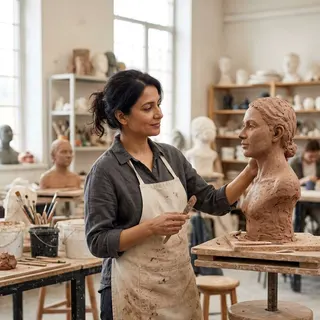 Fine Arts Instructor
 Junior Coding
Block based, project first coding using Scratch, MIT's own constructionist platform, built on the idea that children learn best by building things that genuinely interest them. Free, browser based, no special hardware required.
- ◆ Sequencing and events: a program is a set of steps, run in order
- ◆ Loops, then conditionals ("if this, then that"), the two ideas underneath almost all software
- ◆ Variables, introduced through a simple scorekeeping game a child actually wants to finish
- ◆ Debugging as a normal, expected part of building, not a sign something went wrong
- ◆ A capstone: an original game or interactive story, designed and built solo
Small group sizes, so the instructor sees every child's actual project each session, not a general demonstration. Exact schedule and group size confirmed at enrolment.
 Coding Instructor
 Different materials. The same finished habit.
Safeguarding for this age group is stricter, not the same.
Every session with a named parent or guardian aware of the schedule in advance. No one to one unsupervised sessions with this age group without a second adult aware in real time. No comparative ranking between children, ever. Photography or sharing of a child's work requires its own separate, explicit written consent. Read our full Safeguarding Statement.
What you can actually expect.
A finished sculpture or a playable game at the end of term, shared with you directly, not a certificate describing progress in the abstract.
A named parent or guardian is aware of the schedule and progress throughout, consistent with the safeguarding standard below, not just at a single showcase.
This is about building the habit of finishing a hard, self directed thing, at an age where that habit is still forming, not about producing a prodigy in either art or code.
From a first sculpture or a first game, to a research career.
When a junior is ready for research level work, the Foundation Programme is the natural next step.
Ask About Enrolment